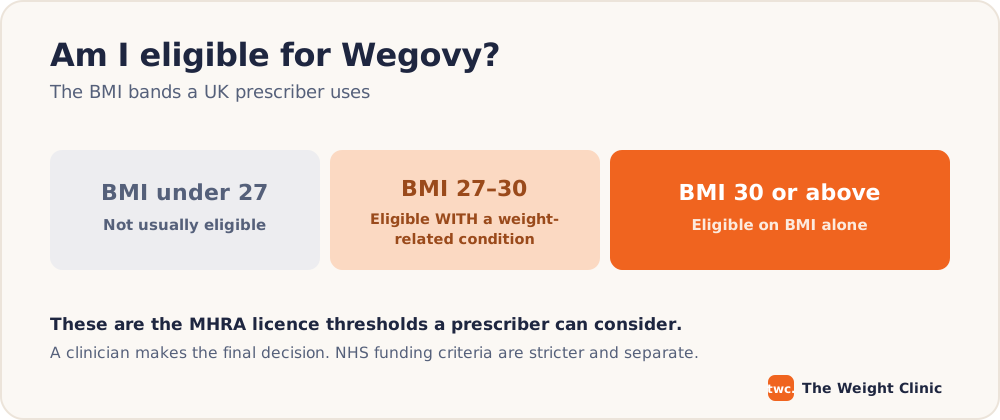
If you're wondering whether you can get Wegovy in the UK, the short answer is this: you'll usually qualify if your BMI is 30 or above, or 27 or above with a weight-related health condition such as high blood pressure, raised cholesterol, prediabetes or obstructive sleep apnoea. That's the threshold set out in the medicine's UK licence. Wegovy (semaglutide) is a prescription-only medicine, so meeting the BMI rule is the starting point rather than the whole story — a prescriber still has to review your health history and confirm the treatment is safe for you.
This guide walks through exactly what "eligible" means: the BMI numbers, which health conditions count, who can't take it, and how the private route differs from the NHS. No vague lifestyle sermon — just what a prescriber actually looks at.
The BMI rule: 30, or 27 with a health condition
Body mass index is where every assessment begins. It's a rough measure — it can't tell muscle from fat, and it treats everyone's body shape the same — but it's still the yardstick the medicine's licence is written around, because BMI tracks reasonably well with the health risks that come from carrying excess weight.
Wegovy is licensed in the UK for weight management in adults, alongside a reduced-calorie diet and increased physical activity, in two groups:
| Your BMI | What else you need | Eligible? |
|---|---|---|
| 30 or above (obesity) | Nothing further required by the licence | Yes, on the BMI alone |
| 27 to 29.9 (overweight) | At least one weight-related health condition | Yes, if a qualifying condition is present |
| Under 27 | — | No — below the licensed threshold |
So if your BMI is 30 or more, you meet the weight criterion on its own. Between 27 and 30, the door isn't shut, but it opens only if your weight is already contributing to another medical problem. A BMI of 28 with no related conditions won't meet the licence; a BMI of 28 with treated hypertension usually will. These thresholds come straight from the Wegovy Summary of Product Characteristics, the official prescribing document approved by the Medicines and Healthcare products Regulatory Agency (MHRA).
Two things worth knowing early. First, the licence is for adults aged 18 and over. Second, weight loss on Wegovy isn't a given — the medicine reduces appetite, but it works with a lower-calorie diet and more movement, not instead of them. Standard prescribing practice is to review your progress rather than repeat-prescribe indefinitely: prescribers typically check how you're doing at around four to six months, and if you haven't lost roughly 5% of your body weight, they'll usually stop treatment because it's unlikely to be worth continuing. That periodic-review step is built into the medicine's prescribing guidance, not a one-off box-tick.
Which health conditions count at BMI 27 to 30
If your BMI sits in the 27 to 30 band, one qualifying condition is the difference between eligible and not. A "weight-related comorbidity" isn't a minor complaint — it's a documented condition that your weight is driving and that losing weight can genuinely improve. The common ones a prescriber will accept include:
- High blood pressure (hypertension) — a constant strain on your arteries and a leading risk factor for stroke and heart disease.
- Raised cholesterol or triglycerides (dyslipidaemia) — a sign your metabolism is struggling to handle fats, which loads risk onto your heart.
- Prediabetes or impaired glucose regulation — insulin resistance heading toward type 2 diabetes; treating weight at this stage is far easier than after a diabetes diagnosis.
- Type 2 diabetes — often improves substantially with weight loss.
- Obstructive sleep apnoea — where excess weight narrows the airway during sleep, leaving you oxygen-starved and exhausted.
- Polycystic ovary syndrome (PCOS) — the insulin resistance that makes weight loss so difficult for many women.
- Weight-related joint problems (osteoarthritis) — where knees or hips can no longer support the activity that would help.
You'll need to give evidence of the condition during your consultation — a diagnosis, current medication, or recent readings. It doesn't have to be dramatic; treated high blood pressure counts. The principle is straightforward: in this BMI band, treatment is justified by the medical problem the weight is already causing, not by the number on the scale alone.
A note on the NHS's tighter rules
You may have read about lower BMI thresholds — such as 27.5 for obesity, or 25 with a condition — for people of South Asian, Chinese, Black African, African-Caribbean and some other backgrounds, who develop weight-related health risks at lower weights. Those adjusted figures come from NICE, the body that decides what the NHS funds, and they apply to NHS-funded specialist services. The MHRA licence that governs private prescribing uses the 30 / 27-plus-condition rule for all adults. A good prescriber will still take your ethnicity and individual risk into account when weighing up whether treatment suits you — it's clinically relevant even where it doesn't change the headline number.
Who can't take Wegovy
Some histories make Wegovy unsafe regardless of BMI, and a prescriber will decline treatment where they apply. These aren't hurdles for their own sake — they exist because semaglutide changes how your gut, pancreas and appetite behave, and a few pre-existing conditions turn that into a real hazard.
A personal or family history of medullary thyroid carcinoma (MTC), or Multiple Endocrine Neoplasia syndrome type 2 (MEN 2). In animal studies, GLP-1 medicines caused thyroid C-cell tumours. This hasn't been shown to happen in humans, but the caution is written into the licence, so these rare conditions in you or a close relative rule the medicine out. To be clear, a common underactive thyroid or Hashimoto's is not the same thing and usually doesn't affect eligibility.
A history of pancreatitis. Semaglutide has been linked to pancreatitis in rare cases, so previous inflammation of the pancreas is a significant concern.
Pregnancy, trying to conceive, or breastfeeding. Wegovy isn't used in any of these situations. Because the medicine lingers in your system, you should stop it at least two months before trying to conceive.
Severe gastrointestinal disease, such as gastroparesis (delayed stomach emptying) or serious inflammatory bowel disease, because the medicine deliberately slows the stomach further.
Type 1 diabetes, or use alongside certain other diabetes medicines without close supervision, and any known allergy to semaglutide.
Honesty here is the whole point. Hiding a history of pancreatitis or a thyroid cancer in the family to get past the checks doesn't beat the system — it removes the safeguard that's there to protect you. If your answers don't add up, or a condition makes the medicine unsafe, a responsible prescriber won't issue it.
Understanding side effects and the Yellow Card scheme
Most people tolerate Wegovy, but no effective medicine is risk-free. The common side effects are gastrointestinal — nausea, diarrhoea, constipation, and stomach discomfort — usually strongest when you start or increase the dose, and easing as your body adjusts. Rare but serious risks include pancreatitis (severe, persistent stomach pain that can spread to your back) and gallbladder problems such as gallstones, which can become more likely during rapid weight loss.
If you ever experience a side effect while taking Wegovy, you can report it directly to the MHRA through the Yellow Card scheme at yellowcard.mhra.gov.uk. It's the UK's official system for monitoring medicine safety, and patient reports genuinely feed into how medicines are watched. Anyone deciding whether Wegovy is right for them should weigh the everyday side effects and the rare serious ones against the health risks of untreated obesity — a balance your prescriber will talk through with you.
How well does Wegovy actually work?
Eligibility is worth little if the treatment doesn't deliver, so it's fair to ask what the evidence shows. In the STEP 1 trial — 68 weeks, adults with obesity or overweight-plus-a-condition, on the full 2.4 mg weekly dose alongside lifestyle changes — participants lost an average of around 14.9% of their body weight, compared with about 2.4% on placebo. Results vary from person to person; some lose considerably more, others less, and a minority don't respond well enough to continue.
For context, its main alternative, Mounjaro (tirzepatide), produced an average of around 22.5% total body-weight loss on the top 15 mg dose over 72 weeks in the SURMOUNT-1 trial. That doesn't make Wegovy a lesser choice — the right medicine depends on your health history, how you tolerate it, and cost — but if you're comparing the two, our Mounjaro vs Wegovy guide sets them side by side. There's also a newer oral route: our Wegovy Tablet guide explains where an oral semaglutide tablet fits in.
NHS vs private: two routes to the same medicine
Qualifying is one thing; getting a prescription in hand is another, and the two UK routes run on very different timelines.
On the NHS, most GPs can't prescribe Wegovy directly. You're referred to a specialist weight-management service, and those services are heavily oversubscribed — waits can run to many months. NHS treatment also tends to come with strict rules, including limits on how long you can stay on it, driven partly by cost and capacity rather than by your individual clinical need.
The private route skips the referral. A regulated online pharmacy assesses your eligibility through an online consultation reviewed by a UK-registered prescriber, and if it's approved and suitable, your medicine is delivered to your door. "Private" doesn't mean unregulated: a legitimate provider works under the same GPhC and MHRA standards as any NHS pharmacy. The trade-off is straightforward — you pay for the medicine and the service, but you skip the queue and get continuity of care rather than an arbitrary cut-off. If you're weighing this up, see our guide to spotting a legitimate UK online pharmacy.
How it works at The Weight Clinic
The Weight Clinic is a GPhC-registered UK online pharmacy, and eligibility here is a clinical decision, not a checkout step. You complete a confidential online questionnaire covering your height and weight, medical history, current medicines and allergies. A prescriber — not an automated system — reviews it, checks it against the criteria above, and only approves treatment where it's genuinely appropriate. We ask for photo ID and, where needed, weight verification, because we're a regulated pharmacy rather than a shop.
Wegovy starts from £115 a month plus £5 tracked delivery per order, there's no subscription, and the eligibility check itself is free. If Wegovy isn't right for you, our clinicians will say so — and may suggest an alternative such as Mounjaro or Foundayo.
Not sure where you stand? You can check your eligibility in a few minutes — it's free, and there's no obligation to go ahead.
The bottom line
Wegovy eligibility in the UK comes down to a clear set of checks: a BMI of 30 or more, or 27 or more with a weight-related health condition; no history that makes semaglutide unsafe, such as certain thyroid cancers or pancreatitis; and a prescriber's judgement that the benefit outweighs the risk for you specifically. Meet those, and treatment is an option — whether through an NHS specialist service or a regulated private pharmacy. To go deeper on related questions, see our guides to Wegovy side effects and Mounjaro eligibility, or read more about weight-loss injections generally.
Frequently asked questions
What BMI do you need to get Wegovy in the UK?
Under the UK licence, you're eligible with a BMI of 30 or above, or a BMI of 27 to 29.9 if you also have at least one weight-related health condition such as high blood pressure, raised cholesterol, prediabetes or obstructive sleep apnoea. Meeting the BMI rule is the starting point; a prescriber still reviews your full health history before deciding Wegovy is safe and suitable.
Which health conditions qualify you for Wegovy at a BMI of 27 to 30?
Common qualifying conditions include high blood pressure (hypertension), raised cholesterol or triglycerides (dyslipidaemia), prediabetes or type 2 diabetes, obstructive sleep apnoea, PCOS, and weight-related osteoarthritis. You'll be asked to give evidence during your consultation, such as a diagnosis, current medication or recent readings.
Who can't take Wegovy?
Wegovy is not suitable if you have a personal or family history of medullary thyroid carcinoma or MEN 2, a history of pancreatitis, severe gastrointestinal disease such as gastroparesis, or type 1 diabetes, or if you're pregnant, breastfeeding or trying to conceive. A known allergy to semaglutide also rules it out. A prescriber will decline treatment where any of these apply.
How much weight can you lose on Wegovy?
In the STEP 1 trial (68 weeks, 2.4 mg weekly dose alongside lifestyle changes), participants lost an average of around 14.9% of their body weight versus about 2.4% on placebo. Results vary from person to person — some lose more, others less, and a minority don't respond well enough to continue.
How much does Wegovy cost at The Weight Clinic?
Wegovy starts from £115 a month, plus £5 tracked delivery per order. There's no subscription, and the eligibility check itself is free. Wegovy is prescription-only and is supplied only after an online consultation and clinical assessment by a UK-registered prescriber.