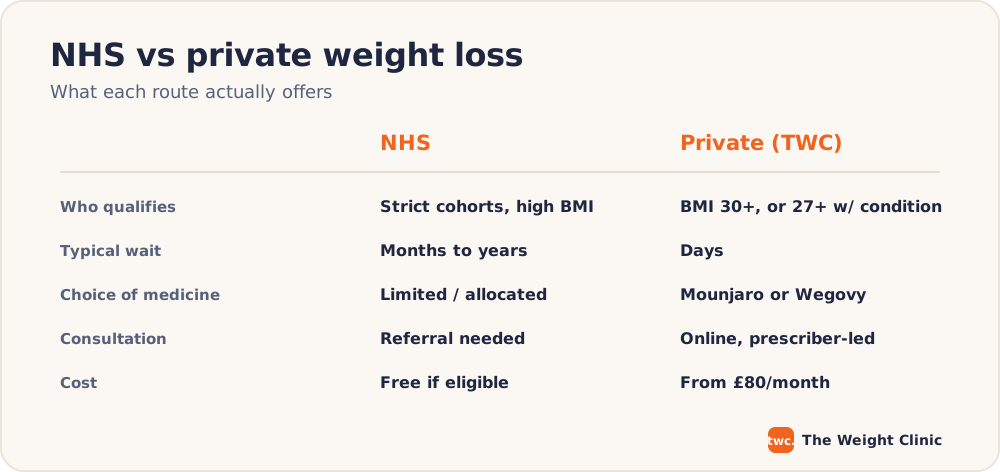
If you have looked into weight loss medication on the NHS and come away confused or on a waiting list, you are not alone. The short version: the same medicines are available through both routes, but who qualifies, how long you wait, and how much you pay are completely different. The NHS rations these treatments tightly to the highest-risk patients and can involve waits measured in months or years. A regulated private pharmacy assesses you against the medicine's own licensed criteria, which are broader, and can usually reach a prescribing decision within a day or two — provided a prescriber judges it safe for you.
This guide walks through both options honestly: who the NHS will actually treat, how private eligibility differs, what Mounjaro and Wegovy realistically achieve, the safety picture you need to weigh up, and how to tell a properly regulated clinic from a risky one.
Why so few people get weight loss medication on the NHS
The medicines themselves are not the bottleneck — access is. NHS weight management is organised into tiers. Tiers 1 and 2 cover lifestyle advice and community weight programmes. Tier 3 is where specialist multidisciplinary teams manage prescription treatments such as tirzepatide (Mounjaro) and semaglutide (Wegovy), and it is the tier that most people struggle to reach. Referral routes are limited, capacity is stretched, and in many areas the wait for a specialist assessment runs to the better part of a year.
There is also a deliberate policy layer on top. When NICE recommended tirzepatide for weight management on the NHS, it set out a phased rollout over several years and prioritised those at highest clinical risk first — so being eligible on paper does not mean treatment is available to you now. NICE's guidance explicitly frames this as a staged introduction to manage demand and cost.
The result is a large group of people who are medically suitable for treatment but sit outside the current NHS priority window: too high-risk to be told "just diet and exercise," not high-risk enough to reach the front of a Tier 3 queue. If that describes you, looking at a regulated private option is a reasonable, informed choice — not queue-jumping.
NHS vs private: how eligibility actually differs
This is where most of the confusion lives, so it is worth being precise. There are two separate sets of rules, and they are not the same thing.
The MHRA licence (the marketing authorisation that says who a medicine may be prescribed to) is broad. For weight management, Mounjaro and Wegovy are licensed for adults with a BMI of 30 or above, or a BMI of 27 or above alongside a weight-related health condition such as high blood pressure, type 2 diabetes, high cholesterol or obstructive sleep apnoea. That is the standard a properly regulated UK pharmacy works to.
The NHS funding criteria are stricter and layered on top of the licence to manage cost. For NHS-funded tirzepatide, NICE's staged rollout starts with people who have a higher BMI and several weight-related conditions, and prioritises them by risk band. So a person can be fully eligible under the medicine's licence yet fall outside what the NHS will currently fund — the difference is budget and prioritisation, not safety.
Here is the practical comparison.
| NHS route | Regulated private pharmacy | |
|---|---|---|
| Eligibility basis | NICE funding criteria (stricter, phased by risk) | MHRA licensed criteria: BMI 30+, or 27+ with a weight-related condition |
| Typical BMI entry point | Higher BMI plus multiple weight-related conditions | 30+, or 27+ with one weight-related condition |
| Route to assessment | GP referral into a tiered pathway | Direct online consultation |
| Typical wait | Often months; a specialist wait can approach a year | Usually a prescriber decision within a day or two |
| Cost to you | Standard NHS prescription charge (if eligible) | You pay for the medicine and clinical oversight |
| Clinical assessment | Yes | Yes — a prescriber reviews every request |
The one thing that never differs is the safety gate. Both routes require an assessment by a qualified prescriber, and both are prescription-only. No legitimate service, NHS or private, supplies these medicines without a consultation and a clinical decision that treatment is appropriate for you. If a website offers to sell them "without a prescription," that is a warning sign, not a shortcut. You can see where you stand against the licensed criteria with a free eligibility check before you commit to anything.
What the medicines actually do — and what to expect
Mounjaro and Wegovy are not "fat-melting" injections and the "skinny jab" label undersells how they work. They are hormone-based medicines that act on the gut–brain signals controlling appetite and fullness. Semaglutide (Wegovy) targets the GLP-1 receptor. Tirzepatide (Mounjaro) targets both GLP-1 and GIP receptors, which is why it tends to produce larger average weight loss in trials. They reduce hunger and help you feel full sooner, which makes a calorie deficit far more achievable — but they work alongside diet and activity changes, not instead of them.
The evidence for each is genuinely strong, and it matters that the numbers come from named trials rather than marketing.
- Tirzepatide (Mounjaro): In the SURMOUNT-1 trial, adults without diabetes taking the 15mg dose lost about 22.5% of body weight on average over 72 weeks, alongside diet and exercise, compared with placebo.
- Semaglutide (Wegovy): In the STEP-1 trial, adults taking the 2.4mg dose lost about 14.9% of body weight on average over 68 weeks, again alongside lifestyle support.
Two caveats worth stating plainly. First, these are averages from clinical trials — individual results vary widely, and some people lose considerably less. Second, both figures reflect treatment combined with structured diet and activity support, and much of the benefit is maintained only while treatment continues. These are tools for long-term management, not a short course.
If you want to weigh the two head to head, our detailed Mounjaro vs Wegovy comparison breaks down dosing, results and cost side by side.
What about a tablet instead of an injection?
For people who are needle-averse, there is now an oral option. Orforglipron — the once-daily tablet branded Foundayo — received its UK marketing authorisation in August 2026, and we prescribe and dispense it in 0.8mg, 2.5mg and 9mg, with the higher strengths expected in late September 2026. An oral form of semaglutide, the Wegovy Tablet, is also available. Our guide to the Wegovy Tablet and oral semaglutide covers where things actually stand.
The safety picture you should weigh up
Effective medicines have real side effects, and an honest comparison has to include them. The most common effects are gastrointestinal — nausea, constipation, diarrhoea, and indigestion — and they are usually most noticeable when you start or increase a dose. Starting low and increasing slowly is the main way these are kept manageable.
For Mounjaro, that means a 2.5mg starting dose, with increases of 2.5mg no sooner than every four weeks, up to a maximum of 15mg — and not everyone needs to reach the top dose. This gradual titration exists specifically to reduce side effects; it is not a delay tactic.
There are also serious-but-rare risks that deserve naming rather than glossing over. These include pancreatitis (inflammation of the pancreas, which can cause severe, persistent abdominal pain) and gallbladder problems such as gallstones, which can become more likely with rapid weight loss. These medicines are also not suitable for everyone: key contraindications include pregnancy and breastfeeding, a personal or family history of medullary thyroid carcinoma, and multiple endocrine neoplasia syndrome type 2. This is exactly why the prescriber assessment is not a formality — it exists to screen these out.
If you do experience a side effect, you can report it directly to the MHRA Yellow Card scheme at yellowcard.mhra.gov.uk, which helps the Medicines and Healthcare products Regulatory Agency monitor medicine safety across the UK. And if you develop severe, persistent abdominal pain, seek urgent medical help rather than waiting. For a fuller breakdown, see our guides to Mounjaro side effects and Wegovy side effects.
How to tell a safe private clinic from a risky one
The private market has genuinely good, properly regulated pharmacies — and it also has unregulated sellers who treat prescription medicines like retail products. The difference is not cosmetic; it is the difference between clinical care and a gamble with counterfeit or badly stored medication.
A legitimate UK provider will always:
- Be a GPhC-registered pharmacy with a checkable registration number and a real UK address. You can look up any registered pharmacy on the General Pharmaceutical Council register at pharmacyregulation.org/registers — a genuine provider will be listed there.
- Require a full consultation and medical history before prescribing, and be willing to decline if treatment is not safe for you.
- Have prescribing overseen by named, registered clinicians — at The Weight Clinic that is Superintendent Pharmacist Andrew Lane and Pharmacist Independent Prescriber Fatma Al Sibahi.
- Ship these temperature-sensitive medicines in appropriate cold-chain packaging, since they need to be kept refrigerated between roughly 2°C and 8°C to stay effective.
The warning signs are just as clear: anyone selling via social media direct messages, prices that look too good to be true, no physical UK address, and — above all — any offer to supply without a prescription or medical questions. If a seller does not care about your medical history, they are not looking after your safety.
How it works at The Weight Clinic
We are a GPhC-registered UK online pharmacy, and the process is built around the same safety gate the NHS uses — just without the tiered wait.
- Complete a free eligibility check and consultation. You answer questions about your BMI, medical history and current medications. There is no charge to find out whether treatment is likely suitable.
- A prescriber reviews your request. A UK-registered clinician assesses you against the licensed criteria and your health history, usually within a day or two. If it is not safe or appropriate, we will tell you and explain why — we do not prescribe to everyone.
- If approved, your medicine is dispensed and delivered. Mounjaro starts at 2.5mg and is titrated gradually. Everything ships in discreet, temperature-controlled packaging, and re-ordering for maintenance is straightforward.
On cost, we keep it transparent and there is no subscription: Mounjaro starts from £160 a month, and Wegovy from £115 a month, plus £5 tracked delivery per order. You pay as you go, with no lock-in.
If you have been stuck waiting or told you do not quite qualify on the NHS, the sensible next step is simply to find out where you stand. Check your eligibility — it is free, and a prescriber, not an algorithm, makes the final call.
For more on the medicines and pathways mentioned here, see our overviews of Mounjaro, Wegovy and the full range of weight loss injections.
Frequently asked questions
Can I get Mounjaro or Wegovy on the NHS? Yes, but eligibility is tightly restricted. NHS-funded treatment follows NICE's criteria and a phased rollout that prioritises people at the highest clinical risk first, so many people who meet the medicine's licensed criteria still cannot access it on the NHS right now. A regulated private pharmacy assesses you against the broader licensed criteria (BMI 30+, or 27+ with a weight-related condition), but you pay for the medicine and clinical oversight.
Is a private weight loss clinic a legitimate alternative to the NHS? It can be, provided the clinic is a GPhC-registered UK pharmacy that requires a full consultation and prescribes only after a clinician judges it safe. Legitimate private care is not a way to bypass safety checks — the assessment and prescription requirement are the same. Always verify the pharmacy's GPhC registration and check for a real UK address before starting.
Do I need to tell my GP if I start treatment privately? It is strongly recommended. Keeping your GP informed means your medical record stays accurate and helps avoid interactions with other medicines. A responsible private provider will ask for your consent to share your treatment details with your GP as a standard safety step.
How much weight will I actually lose? That varies a lot between individuals. In trials, average loss was about 22.5% of body weight over 72 weeks on tirzepatide (Mounjaro) at 15mg in SURMOUNT-1, and about 14.9% over 68 weeks on semaglutide (Wegovy) at 2.4mg in STEP-1 — both alongside diet and activity changes. Those are averages, not guarantees, and much of the benefit is maintained only while treatment continues.
What if I don't qualify during the consultation? Then we will not prescribe, and we will explain why. That might be because your BMI is below the licensed threshold or because you have a health condition that makes treatment unsafe. The point of the assessment is to protect you, so a "no" is a clinical decision, not a sales failure. We can point you toward suitable alternatives.
Are these medicines safe? For suitable people, they have a well-studied safety profile, but no medicine is risk-free. The common side effects are gastrointestinal and usually settle with slow dose increases. Rare but serious risks include pancreatitis and gallbladder problems, and the medicines are not suitable in pregnancy or for people with certain thyroid conditions — which is why a prescriber assessment is essential. Any side effect can be reported through the MHRA Yellow Card scheme at yellowcard.mhra.gov.uk.
Frequently asked questions
Can I get Mounjaro or Wegovy on the NHS?
Yes, but eligibility is tightly restricted. NHS-funded treatment follows NICE's criteria and a phased rollout that prioritises people at the highest clinical risk first, so many people who meet the medicine's licensed criteria still cannot access it on the NHS right now. A regulated private pharmacy assesses you against the broader licensed criteria (BMI 30+, or 27+ with a weight-related condition), but you pay for the medicine and clinical oversight.
Is a private weight loss clinic a legitimate alternative to the NHS?
It can be, provided the clinic is a GPhC-registered UK pharmacy that requires a full consultation and prescribes only after a clinician judges it safe. Legitimate private care is not a way to bypass safety checks — the assessment and prescription requirement are the same. Always verify the pharmacy's GPhC registration and check for a real UK address before starting.
Do I need to tell my GP if I start treatment privately?
It is strongly recommended. Keeping your GP informed means your medical record stays accurate and helps avoid interactions with other medicines. A responsible private provider will ask for your consent to share your treatment details with your GP as a standard safety step.
How much weight will I actually lose?
That varies a lot between individuals. In trials, average loss was about 22.5% of body weight over 72 weeks on tirzepatide (Mounjaro) at 15mg in SURMOUNT-1, and about 14.9% over 68 weeks on semaglutide (Wegovy) at 2.4mg in STEP-1 — both alongside diet and activity changes. Those are averages, not guarantees, and much of the benefit is maintained only while treatment continues.
What if I don't qualify during the consultation?
Then we will not prescribe, and we will explain why. That might be because your BMI is below the licensed threshold or because you have a health condition that makes treatment unsafe. The point of the assessment is to protect you, so a "no" is a clinical decision, not a sales failure. We can point you toward suitable alternatives.
Are these medicines safe?
For suitable people, they have a well-studied safety profile, but no medicine is risk-free. The common side effects are gastrointestinal and usually settle with slow dose increases. Rare but serious risks include pancreatitis and gallbladder problems, and the medicines are not suitable in pregnancy or for people with certain thyroid conditions — which is why a prescriber assessment is essential. Any side effect can be reported through the MHRA Yellow Card scheme at yellowcard.mhra.gov.uk.