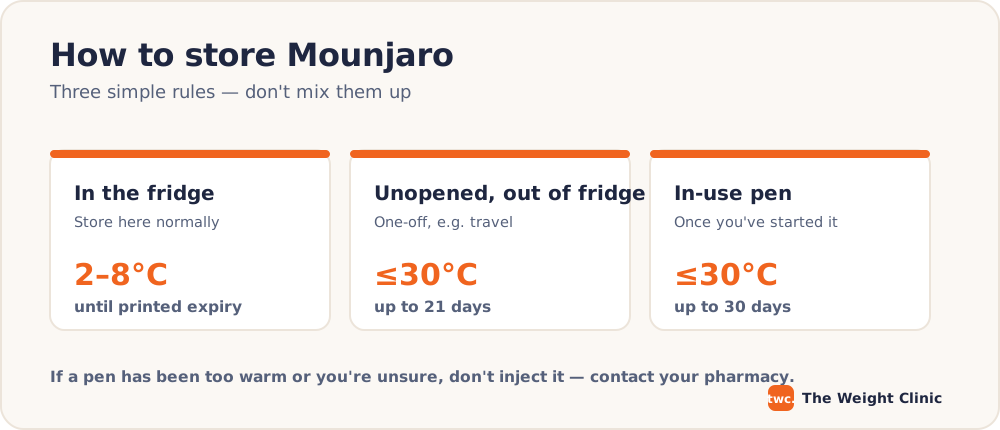
The short answer: keep your unused Mounjaro (tirzepatide) pens in the fridge at 2–8°C, never in the freezer, and keep them in the original carton to protect them from light. Once you start using a pen — or if a fridge isn't practical — Mounjaro can sit at room temperature (up to 30°C) for a limited window, then it must be thrown away. Get the temperature and the timing right and the medicine works exactly as it should. Get it badly wrong — freezing, or a long spell in the heat — and it may quietly lose potency, which is why the manufacturer's advice is firm: if you're in any doubt, don't inject it, and ask your pharmacy.
This guide walks through the fridge rules, the exact out-of-fridge allowances, how to travel with Mounjaro (including flights), what to do if a pen has been left out or frozen, and how to dispose of your needles safely. Everything here follows the UK Mounjaro Summary of Product Characteristics (SmPC) and patient information leaflet — always read the leaflet that comes in your own box, because the numbers depend on your strength and pen type and they matter.
Where should Mounjaro be kept — fridge or room temperature?
For anything you're not currently using, the fridge is the right home. Store unopened Mounjaro pens in a refrigerator at 2°C to 8°C, in the original carton, and keep them there until you need them. The carton isn't just packaging — it protects the solution from light, which is part of keeping the medicine stable.
A few practical rules for the fridge:
- Don't put pens against the back wall or in the coldest zone. The back of a fridge, and the area near the cooling vents, can dip below zero. The middle shelf or a door shelf is usually safest.
- Never freeze Mounjaro. If it has been frozen — even once, even if it looks fine after thawing — it must not be used. Freezing can damage the medicine in ways you can't see.
- Check your fridge is actually running at 2–8°C. Many home fridges run colder than people expect. A cheap fridge thermometer is a genuinely worthwhile buy if you're storing several months of pens.
- Keep it out of reach of children. Standard advice, but worth repeating for an injectable.
If you don't have reliable fridge space, or you're partway through a course, the good news is that Mounjaro doesn't have to live in the fridge the whole time — which brings us to the out-of-fridge allowance. There are actually two different room-temperature windows, and it's worth knowing which one applies to you.
How long can Mounjaro stay out of the fridge?
This is the question that causes the most anxiety, so here's the clear version. The UK product information gives Mounjaro a room-temperature allowance, but the rule is different depending on whether the pen is unopened or already in use — and in both cases there's a maximum temperature and a maximum number of days. Cross either line and the pen has to go.
There are two separate windows:
- An unopened pen taken out of the fridge can be stored at up to 30°C for a maximum of 21 days. This is a one-way move: once an unopened pen has left the fridge for room-temperature storage, the 21-day clock is running and it can't be "reset" by going back cold.
- A pen that's in use (once you've taken the first dose) can be kept at up to 30°C for up to 30 days. After that 30-day window the pen must be discarded, even if there's solution left in it.
The KwikPen is the multi-dose pen that holds four weekly doses; Mounjaro is also supplied in single-dose pre-filled pens. The 21-day-unopened and 30-day-in-use limits are the figures given in the UK product information, but the exact wording and any pen-specific detail can differ, so always read the leaflet for your own strength and pen type rather than relying on a single number.
Here's the at-a-glance version:
| Situation | Where to keep it | Temperature | How long |
|---|---|---|---|
| Unopened pens, refrigerated | Fridge, in the carton | 2–8°C | Until the printed expiry date |
| Unopened pen, taken out of the fridge | Room temperature, cool spot | Up to 30°C (never frozen) | Up to 21 days, then discard |
| In-use pen (first dose taken) | Room temperature, cool spot | Up to 30°C (never frozen) | Up to 30 days, then discard |
| Freezer | Never | Below 0°C | Do not use if frozen — discard |
A couple of things people find reassuring — but read the detail, because the two windows behave differently. For an in-use pen, the manufacturer's data supports cycling it between the fridge and room temperature during that 30-day in-use period without harming it, so taking a pen out and later putting it back is fine, as long as you stay inside the overall 30-day count. That flexibility applies to the in-use window; an unopened pen you've moved to room temperature is on the fixed 21-day clock regardless of whether you put it back in the fridge. And in both cases, the day-count isn't a reason to panic if a pen sat on the kitchen counter for an hour while you found your keys — a short spell at normal room temperature is well within either allowance.
The hard limits are the ones to respect: above 30°C, frozen, and — for a pen that's been taken out of the fridge — the day count (21 days unopened, 30 days in use). A car glovebox in a UK summer, a windowsill in direct sun, or a bag left in a hot car can all exceed 30°C surprisingly fast.
How to travel with Mounjaro
Travel is completely doable — thousands of people on tirzepatide do it every week — it just needs a little planning.
For day trips and short journeys, a small insulated cool bag with an ice pack is plenty. The key is to stop the pen touching the ice pack directly, because you're trying to keep it cool, not freeze it. Wrap the ice pack in a cloth, or use a cool bag with a divider, and keep the pen in its carton.
For flights, always pack Mounjaro in your hand luggage, never the hold. The hold is unpressurised for temperature and can drop below freezing at altitude — exactly the condition that ruins the medicine. Hand luggage keeps it with you and at cabin temperature.
A quick checklist for flying with Mounjaro:
- Carry a copy of your prescription or a pharmacy letter. Injectable medicines are allowed through security, but a supporting note makes the conversation with airport staff much shorter. If you're travelling from The Weight Clinic, ask us for a travel letter before you go.
- Keep pens in the original labelled carton so the medication name and your details are visible.
- Use a medical cool bag rated to hold 2–8°C for the length of your journey — travel-specific insulin/GLP-1 cooling cases are widely available and work well for door-to-door trips.
- At your destination, get pens back into a fridge where you can — a hotel minibar fridge works, but check it isn't set to freezing.
- Watch the day count as well as the temperature. If you're carrying unopened pens out of the fridge for a longer trip, remember they can only spend 21 days at up to 30°C before they must be discarded — the calendar is a hard limit, not just the thermometer. For an in-use pen the equivalent limit is 30 days. In a hot country the 30°C ceiling matters too, so watch both the number of days and the heat.
If your trip is longer than the room-temperature allowance and you can't guarantee a fridge, speak to your pharmacy before you travel — it's better to plan the supply than to gamble with a pen that may have overheated or run past its day count.
What to do if Mounjaro has been left out too long — or frozen
Everyone worries about this, so here's the calm, correct answer.
If a pen has frozen — left in the coldest part of the fridge, or exposed to sub-zero temperatures in transit — do not use it, even if it has thawed and looks normal. Frozen tirzepatide should be discarded, and you should contact your pharmacy for a replacement.
If a pen has been left at room temperature, the questions are: how hot did it get, for how long, and was it unopened or already in use? If it stayed under 30°C and within its allowed number of days — 21 days for an unopened pen out of the fridge, 30 days for an in-use pen — it's fine to use. If it went above 30°C, sat somewhere hot (a sunny windowsill, a hot car, a radiator), or has been out longer than its allowance, treat it as compromised.
The manufacturer's guidance — and ours — is simple: if you are in any doubt, do not inject it. Set it aside and contact your pharmacy for advice. A wasted pen is a nuisance; injecting a pen that has lost potency means you may not get the treatment you're paying for, and you won't necessarily be able to tell by looking. Also inspect the solution before every injection: Mounjaro should be clear and colourless to slightly yellow. If it's cloudy, discoloured, or has particles in it, don't use it.
If you think a pen has been damaged — overheated, frozen, or otherwise compromised — or you experience anything you suspect is a defect or a side effect, you can report it to the medicines regulator through the MHRA Yellow Card scheme at yellowcard.mhra.gov.uk. Reporting helps the MHRA monitor the safety and quality of medicines.
If you're a Weight Clinic patient and you're unsure about a pen — whether it overheated in the post, got left out, or you just can't remember how long it's been on the side — message us. We'd far rather replace a pen than have you inject one you're worried about.
How to dispose of Mounjaro needles and used pens safely
Every injection produces a used needle, and needles are classed as sharps — they can't go in your normal household bin or recycling.
- Use a sharps bin. Put needles (and used pens, once empty) into a proper puncture-proof sharps container, not a bottle or tub. You can add a sharps bin — and alcohol swabs — to your order at The Weight Clinic if you don't already have one.
- Never re-cap a needle by hand or try to reuse one. A fresh needle every time is safer and less painful.
- Don't overfill the bin — seal it when it reaches the marked line.
- Dispose of the full bin correctly. In the UK, many local councils collect sharps bins or provide drop-off points; some pharmacies take them back. Check your council's website, as arrangements vary by area.
Remove the needle after each injection and store the KwikPen with its cap on (not with a needle attached) between weekly doses — leaving a needle on can let air into the pen and affect the next dose.
How storage works at The Weight Clinic
When you order Mounjaro through The Weight Clinic, it's dispensed by our GPhC-registered pharmacy and sent in temperature-conscious packaging designed to keep it cool in transit. When your parcel arrives, the first job is simple: get the pens into the fridge at 2–8°C, in their carton, unless you're about to start a pen and prefer to keep it at room temperature within the allowance.
Mounjaro is a prescription-only medicine, so we can only supply it after an online consultation and a clinical assessment by one of our prescribers — it isn't something you can buy off the shelf. That assessment checks it's appropriate and safe for you, and it's where any storage or handling questions get answered by a real clinician rather than a leaflet.
If you're weighing up whether Mounjaro is right for you — or comparing it with Wegovy — the honest place to start is a free eligibility check.
Check your eligibility — it's free, takes a few minutes, and there's no subscription. If you'd like to understand the wider route to treatment first, our guide on how to get Mounjaro in the UK covers the consultation, prescribing rules and pricing in plain English.
Safety: the essentials worth knowing
Storage is one part of using Mounjaro well; using it safely is the bigger picture. Tirzepatide is a genuinely effective medicine — in the SURMOUNT-1 trial, adults taking the highest dose (15mg) lost around 22.5% of their body weight on average over 72 weeks, alongside diet and activity changes — but results vary from person to person, and not everyone reaches that figure. By comparison, semaglutide (Wegovy) produced around 14.9% mean weight loss in the STEP-1 trial at 68 weeks. If you're choosing between them, our Mounjaro vs Wegovy comparison lays out the differences.
Like all medicines, Mounjaro has side effects. The common ones are gastrointestinal — nausea, diarrhoea, constipation, and sometimes vomiting or indigestion — and they're usually worst when you start or step up a dose, then settle. Our guide on how long Mounjaro takes to work covers what to expect in those early weeks.
Serious but rare effects include pancreatitis (inflammation of the pancreas — severe, persistent tummy pain, often spreading to the back, needs urgent medical attention) and gallbladder problems such as gallstones. Mounjaro isn't suitable for everyone: it shouldn't be used in pregnancy or when breastfeeding, and there are important contraindications and cautions your prescriber will check — which is exactly why the clinical assessment exists.
On the UK rules: the MHRA (the Medicines and Healthcare products Regulatory Agency) licence lets a prescriber consider Mounjaro for weight management at a BMI of 30 or above, or 27 or above with a weight-related health condition such as type 2 diabetes or high blood pressure. That's the licensing threshold for private prescribing — it's separate from, and less strict than, the NICE thresholds that govern NHS funding.
Finally, if you ever experience a side effect you think might be linked to Mounjaro — or suspect a problem with the medicine itself — you can report it through the MHRA Yellow Card scheme at yellowcard.mhra.gov.uk, and tell us too, so your prescriber has the full picture.
Frequently asked questions
Does Mounjaro have to be kept in the fridge all the time? No. Unused pens should be stored in the fridge at 2–8°C for the long term, but they can also be kept at room temperature (up to 30°C) for a limited time — up to 21 days for an unopened pen taken out of the fridge, and up to 30 days once a pen is in use. It just can't go above 30°C or be frozen, and after its window it must be discarded. Always check your own leaflet for the exact allowance for your strength and pen type.
Can I use Mounjaro if it was left out of the fridge overnight? Almost certainly yes, provided the room stayed under 30°C and the pen is still within its allowed number of days out of the fridge (21 days unopened, 30 days in use). A single night at normal room temperature is well within the manufacturer's allowance. The two things that void a pen outright are going above 30°C or being frozen — if either happened, or you're unsure, don't inject it and contact your pharmacy.
What happens if Mounjaro gets too hot? If a pen has been above 30°C — in a hot car, direct sun, or near a heat source — the medicine may have started to degrade, and you can't tell by looking at it. Don't use it. Set it aside and ask your pharmacy for a replacement. It's not worth risking an ineffective dose.
Can I fly with Mounjaro? Yes. Pack it in your hand luggage — never the hold, which can freeze it — in a medical cool bag, and keep it in the original carton. Carry a copy of your prescription or a pharmacy travel letter to make airport security straightforward, and get pens back into a fridge at your destination where you can. On a longer trip, keep an eye on the day count too: unopened pens out of the fridge last 21 days at up to 30°C, in-use pens 30 days.
How do I know if my Mounjaro has gone bad? Look at the solution before every injection: it should be clear and colourless to slightly yellow. If it's cloudy, discoloured, or has particles, don't use it. Also treat a pen as unusable if it has been frozen, has been above 30°C, or is past its out-of-fridge allowance or printed expiry date. If you suspect a defect, you can report it to the MHRA via the Yellow Card scheme.
Where do I get rid of used Mounjaro needles? In a sharps bin — never your household or recycling bin. Seal it at the fill line and dispose of it through your local council's sharps route or a participating pharmacy; arrangements vary by area, so check your council's website. You can add a sharps bin to your order with us if you need one.
Frequently asked questions
Does Mounjaro have to be kept in the fridge all the time?
No. Unused pens should be stored in the fridge at 2–8°C for the long term, but they can also be kept at room temperature (up to 30°C) for a limited time — up to 21 days for an unopened pen taken out of the fridge, and up to 30 days once a pen is in use. It just can't go above 30°C or be frozen, and after its window it must be discarded. Always check your own leaflet for the exact allowance for your strength and pen type.
Can I use Mounjaro if it was left out of the fridge overnight?
Almost certainly yes, provided the room stayed under 30°C and the pen is still within its allowed number of days out of the fridge (21 days unopened, 30 days in use). A single night at normal room temperature is well within the manufacturer's allowance. The two things that void a pen outright are going above 30°C or being frozen — if either happened, or you're unsure, don't inject it and contact your pharmacy.
What happens if Mounjaro gets too hot?
If a pen has been above 30°C — in a hot car, direct sun, or near a heat source — the medicine may have started to degrade, and you can't tell by looking at it. Don't use it. Set it aside and ask your pharmacy for a replacement. It's not worth risking an ineffective dose.
Can I fly with Mounjaro?
Yes. Pack it in your hand luggage — never the hold, which can freeze it — in a medical cool bag, and keep it in the original carton. Carry a copy of your prescription or a pharmacy travel letter to make airport security straightforward, and get pens back into a fridge at your destination where you can. On a longer trip, keep an eye on the day count too: unopened pens out of the fridge last 21 days at up to 30°C, in-use pens 30 days.
How do I know if my Mounjaro has gone bad?
Look at the solution before every injection: it should be clear and colourless to slightly yellow. If it's cloudy, discoloured, or has particles, don't use it. Also treat a pen as unusable if it has been frozen, has been above 30°C, or is past its out-of-fridge allowance or printed expiry date. If you suspect a defect, you can report it to the MHRA via the Yellow Card scheme.
Where do I get rid of used Mounjaro needles?
In a sharps bin — never your household or recycling bin. Seal it at the fill line and dispose of it through your local council's sharps route or a participating pharmacy; arrangements vary by area, so check your council's website. You can add a sharps bin to your order with us if you need one.