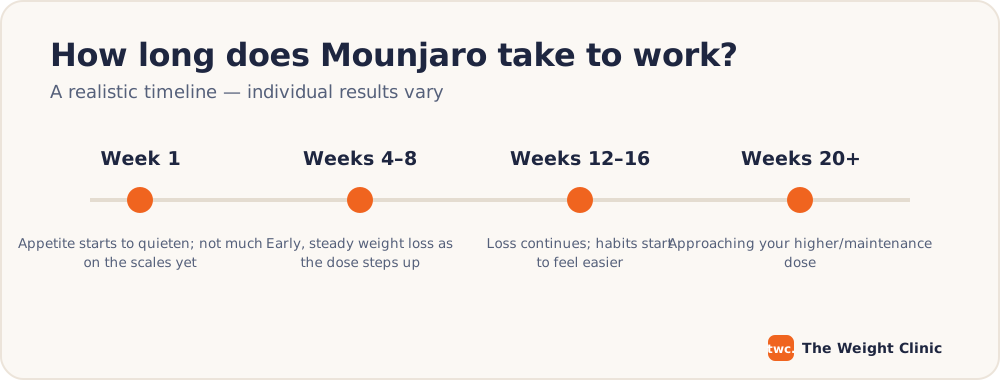
Most people notice something within the first few days: food feels less interesting, portions that used to disappear now sit half-eaten, and the constant background hum of hunger goes quiet. That early appetite change is Mounjaro (tirzepatide) starting to work. Visible, meaningful weight loss takes longer — usually a few weeks to a couple of months — because the dose is deliberately kept low at first and increased slowly.
So the honest short answer is: Mounjaro often starts working within days, but it builds over months. The people who do best are the ones who understand that timeline before they start, rather than checking the scales every morning and panicking in week two.
This guide walks through what actually happens, week by week, and where the headline numbers come from. It is educational only. Mounjaro is a prescription-only medicine in the UK — it can only be supplied after an online consultation and clinical assessment by a prescriber, never bought over the counter.
The quick answer, before we get into detail
- Days 1–7: Appetite usually starts to drop. Weight often barely moves yet.
- Weeks 2–4: Early weight loss becomes noticeable for many people, though it varies a lot.
- Weeks 4–20: The dose is stepped up gradually (this is called titration). Weight loss tends to become steadier and more consistent as the dose rises.
- Months 4–18: The larger losses accumulate here. In the main trial, most people were still losing weight past the six-month mark.
If you take nothing else from this article: Mounjaro is a slow, cumulative medicine by design. Fast is not the goal — steady is.
Why the first dose is deliberately small
Mounjaro is not started at a "full" dose. In the UK it comes in six strengths — 2.5mg, 5mg, 7.5mg, 10mg, 12.5mg and 15mg — and almost everyone begins at 2.5mg once a week.
That starting dose is essentially a settling-in dose. Its main job is to let your gut get used to the medicine and reduce the chance of nausea, not to drive maximum weight loss. Under the MHRA-approved product information, the dose is increased in 2.5mg steps and should not be increased more often than every four weeks. Your prescriber may hold you at a dose for longer if you are still getting side effects, so the calendar below is a typical path, not a fixed rule.
| Weeks (typical) | Dose | What it's mainly for |
|---|---|---|
| 1–4 | 2.5mg | Settling-in dose — tolerability, not weight loss |
| 5–8 | 5mg | First "working" dose for many people |
| 9–12 | 7.5mg | Titration step |
| 13–16 | 10mg | A common maintenance dose |
| 17–20 | 12.5mg | Titration step |
| 21+ | 15mg | Maximum licensed dose |
The licensed maintenance doses for weight management are 5mg, 10mg or 15mg — the 7.5mg and 12.5mg pens are mostly stepping stones to help you tolerate the jump upward. Not everyone climbs all the way to 15mg, and not everyone needs to. Some people do well and settle at 10mg. The "right" dose is the lowest one that gives you a good response with side effects you can live with. We go deeper on this in our Mounjaro dose schedule guide.
Week by week: what to actually expect
Everyone is different, so treat this as a map, not a promise. Two people on the identical dose can have very different experiences.
Week 1 (starting 2.5mg)
The most common change in the first week is not on the scales — it is in your head and your stomach. People describe "food noise" fading: fewer cravings, less snacking, feeling full faster and staying full longer. Some feel this within a day or two of the first injection; for others it takes the full week to notice. Mild nausea, burping or a slightly off stomach can show up here too, especially in the day or so after the jab. Weight may not have moved at all. That is completely normal.
Weeks 2–4 (still on 2.5mg)
This is where many people see their first clear scale movement — often a few pounds — as the reduced appetite starts translating into a genuine calorie deficit. Some of the earliest drop can be water rather than fat, so don't over-read a fast first week or a stall in the second. If side effects appeared, they often begin to ease as your body adjusts. If they don't, that is worth flagging to your prescriber before the dose goes up.
Weeks 5–12 (moving to 5mg, then 7.5mg)
For a lot of people, the step up to 5mg is when the medicine feels like it is genuinely "on." Appetite suppression is usually stronger, and weight loss tends to become more consistent week to week. This is also the phase where habits matter most — protein intake, some resistance activity to protect muscle, and steady eating patterns all help the results stick. A useful checkpoint many prescribers use, drawn from NICE guidance, is whether you have lost around 5% of your starting weight by roughly the six-month mark on the highest dose you can tolerate; NICE frames it the other way round — if you have lost less than that, it is a prompt to review with your prescriber whether to continue rather than an automatic stop.
Weeks 13–24 (10mg and beyond)
By now most people are on a higher, steadier dose and losing weight in a more predictable rhythm — though "predictable" still means with the odd plateau week that then breaks. In the main trial, a post-hoc analysis found that some people were "later responders" who hadn't yet hit 5% loss at week 12 but got there by around week 24, so a slower start does not mean the medicine has failed. If you are one of those, that is a reason to keep going, not to give up.
Months 6–18
This is where the big numbers in the headlines actually come from — they are not month-one figures. Weight loss continues to accumulate for most people well past six months, with a plateau typically arriving later in the first year to 18 months as your body settles at a new set point.
Where the "22.5%" number comes from — and the honest caveat
You will see Mounjaro described as giving "up to around 22.5% weight loss." That figure is real but it needs context, because a number without its source is meaningless.
It comes from SURMOUNT-1, the pivotal trial published in the New England Journal of Medicine. Adults with obesity (or overweight with a weight-related condition), who did not have type 2 diabetes, took the highest dose (15mg) alongside a reduced-calorie diet and more physical activity, over 72 weeks. The average weight loss at the top dose was about 20.9% on the treatment-regimen estimand (counting everyone as randomised), or about 22.5% on the efficacy estimand (people who stayed on treatment as intended). Lower doses gave less — on the same efficacy estimand, around 16% at 5mg and about 21% at 10mg. All of these are averages achieved alongside a reduced-calorie diet and increased physical activity; results vary and not everyone reaches them.
Two things matter here:
- That is an average over nearly a year and a half at the maximum dose — not what to expect by month two. The timeline above exists precisely because you don't start at 15mg.
- Results vary, and not everyone reaches this. Averages hide a wide spread. Some people lose considerably more; some lose less. Nobody can guarantee you a specific number, and any clinic that does is one to walk away from.
For comparison, semaglutide (Wegovy) — the other big name — averaged about 14.9% weight loss (versus roughly 2.4% on placebo) over 68 weeks at its top 2.4mg dose in the STEP-1 trial, again alongside a reduced-calorie diet and increased activity; as with any of these figures, results vary and not everyone reaches them. We put the two head to head in our Mounjaro vs Wegovy comparison, and cover the tablet version on our Wegovy pill (oral semaglutide) page.
What can make Mounjaro work faster — or slower — for you
The medicine does a lot of the heavy lifting, but the pace still depends on the person:
- The dose you're on. Weight loss generally builds as the dose climbs, which is why the first month on 2.5mg is usually the quietest.
- Consistency of injection. Same day each week, not skipping. Missed doses interrupt the momentum.
- What you eat around it. Mounjaro reduces appetite; it doesn't choose your food. Enough protein and a genuine (not extreme) calorie deficit make the difference between losing fat and just losing the scale battle temporarily.
- Muscle and movement. Some resistance activity helps protect muscle so more of what you lose is fat.
- Your own biology. Starting weight, sex, age and metabolism all shift the curve. This is why comparing your week four to someone else's on social media is a fast route to feeling discouraged for no good reason.
If you have lost less than around 5% of your starting weight by roughly the six-month mark on the highest dose you can tolerate, that is a genuine conversation to have with your prescriber about whether to continue — this mirrors how NICE frames the review point in its guidance.
The side effects to expect, and the rare ones to know about
No honest timeline is complete without this part. Mounjaro is generally well tolerated, but side effects are common — especially early and around dose increases.
Common (the ones most people who get side effects will notice):
- Nausea
- Diarrhoea
- Constipation
- Vomiting
- Indigestion, burping, reduced appetite
These are usually mildest if you eat smaller portions, avoid very fatty or heavy meals right after your jab, and stay hydrated. They tend to ease as your body adjusts, which is exactly why the dose is raised slowly.
Serious but rare — stop and seek urgent medical advice if you experience:
- Acute pancreatitis — the MHRA describes this as a known but infrequent side effect, with rare severe or necrotising cases. The red flag is severe, persistent tummy pain that radiates through to your back, sometimes with vomiting; if that happens, stop the medicine and seek urgent medical care. In January 2026 the MHRA strengthened its warnings on GLP-1 and dual GLP-1/GIP medicines after reports of acute pancreatitis, including rare necrotising and fatal cases.
- Gallbladder problems — including gallstones, which can happen with rapid weight loss.
- Signs of low blood sugar, particularly if you also take other diabetes medication.
- Allergic reactions.
Mounjaro is not suitable for everyone. It must not be used in pregnancy or while breastfeeding, and it is contraindicated if you or a close family member has a history of medullary thyroid carcinoma or the genetic condition MEN2 (multiple endocrine neoplasia type 2). It also needs caution alongside certain other conditions and medicines. This is a core reason it is prescription-only: a prescriber checks your history against these contraindications before it is ever supplied.
If you think you've had a side effect from any medicine, you can report it directly to the MHRA through the Yellow Card scheme. Reporting helps make medicines safer for everyone.
Our side effects and how to manage them guide goes through the practical do's and don'ts in more detail.
How it works at The Weight Clinic
The Weight Clinic is a GPhC-registered UK online pharmacy. Because Mounjaro is prescription-only, there is no "add to basket and check out" — every order goes through a clinical route:
- You complete a free eligibility check — a short medical questionnaire.
- A prescriber reviews it against the licensing and safety criteria. The Weight Clinic is a private prescriber operating under Mounjaro's MHRA marketing authorisation, so the eligibility bar we use is the licensed one: a BMI of 30 or more, or 27 or more with a weight-related condition such as high blood pressure or type 2 diabetes (a little lower for some ethnic backgrounds). This is separate from — and less strict than — the NHS-funding rules NICE sets in TA1026 (routine NHS access starts at a BMI of 35 with a comorbidity, or 32.5 for eligible ethnic groups, via a phased rollout); those NICE thresholds govern who the NHS pays for, not who a private prescriber can lawfully treat.
- If Mounjaro is appropriate and safe for you, it is prescribed and dispensed, starting at 2.5mg and titrating up as described above. There is no subscription — you're never locked in.
Our clinical team is led by Superintendent Pharmacist Andrew Lane (GPhC 2027876) and Pharmacist Independent Prescriber Fatma Al Sibahi (GPhC 2232235). Mounjaro starts from £160 a month.
The eligibility check costs nothing and tells you where you stand in a few minutes. Check your eligibility — if it isn't right for you, we'll say so.
You can also browse everything we offer, including Wegovy, on our treatments page.
Frequently asked questions
How quickly will I lose weight on Mounjaro?
Many people notice reduced appetite within the first week, and some visible scale movement within two to four weeks — but this is deliberately gradual because you start on a low 2.5mg dose. The larger, headline-grade losses in the SURMOUNT-1 trial accumulated over 72 weeks at the highest dose. Results vary and not everyone loses the same amount.
Is it normal to lose no weight in the first week of Mounjaro?
Yes, very common. The first week on 2.5mg is mainly about your body getting used to the medicine, and the dose is intentionally low. Appetite change often comes before any change on the scales. A quiet first week or two is not a sign it isn't working.
How long until Mounjaro reaches its full effect?
The dose is stepped up every four weeks or so up to a maximum of 15mg, which means most people don't reach their maintenance dose until around week 16–20 at the earliest. Weight loss then continues to build, with most people still losing past six months and typically plateauing later in the first year to 18 months.
What if Mounjaro isn't working after a few months?
NICE guidance frames the review point like this: if you have lost less than around 5% of your starting weight by roughly six months on the highest dose you can tolerate, that is a prompt to review with your prescriber whether to continue. Some people are "later responders" who reach the 5% mark closer to week 24 rather than week 12, so a slow start is not automatically a failure. If you're genuinely not responding, that's a conversation to have with your prescriber about whether continuing makes sense.
Do I have to reach the 15mg maximum dose?
No. The licensed maintenance doses are 5mg, 10mg or 15mg. The right dose is the lowest one that gives you a good response with tolerable side effects — some people do well and stay at 10mg. Your prescriber tailors this to you rather than pushing everyone to the maximum.
Can I buy Mounjaro to try it faster?
No. Mounjaro is a prescription-only medicine in the UK and can only be supplied after an online consultation and clinical assessment by a prescriber. This isn't red tape for its own sake — it's the check that confirms it's safe for you, screening for contraindications before you ever start. A free eligibility check is the correct first step.
This article is for general information and is not a substitute for individual medical advice. Always read the patient information leaflet and speak to your prescriber or pharmacist about your own circumstances.
Frequently asked questions
How quickly will I lose weight on Mounjaro?
Many people notice reduced appetite within the first week, and some visible scale movement within two to four weeks — but this is deliberately gradual because you start on a low 2.5mg dose. The larger, headline-grade losses in the SURMOUNT-1 trial accumulated over 72 weeks at the highest dose. Results vary and not everyone loses the same amount.
Is it normal to lose no weight in the first week of Mounjaro?
Yes, very common. The first week on 2.5mg is mainly about your body getting used to the medicine, and the dose is intentionally low. Appetite change often comes before any change on the scales. A quiet first week or two is not a sign it isn't working.
How long until Mounjaro reaches its full effect?
The dose is stepped up every four weeks or so up to a maximum of 15mg, which means most people don't reach their maintenance dose until around week 16–20 at the earliest. Weight loss then continues to build, with most people still losing past six months and typically plateauing later in the first year to 18 months.
What if Mounjaro isn't working after a few months?
NICE guidance frames the review point like this: if you have lost less than around 5% of your starting weight by roughly six months on the highest dose you can tolerate, that is a prompt to review with your prescriber whether to continue. Some people are 'later responders' who reach the 5% mark closer to week 24 rather than week 12, so a slow start is not automatically a failure. If you're genuinely not responding, that's a conversation to have with your prescriber about whether continuing makes sense.
Do I have to reach the 15mg maximum dose?
No. The licensed maintenance doses are 5mg, 10mg or 15mg. The right dose is the lowest one that gives you a good response with tolerable side effects — some people do well and stay at 10mg. Your prescriber tailors this to you rather than pushing everyone to the maximum.
Can I buy Mounjaro to try it faster?
No. Mounjaro is a prescription-only medicine in the UK and can only be supplied after an online consultation and clinical assessment by a prescriber. This isn't red tape for its own sake — it's the check that confirms it's safe for you, screening for contraindications before you ever start. A free eligibility check is the correct first step.