If you are weighing up a gastric sleeve against a GLP-1 medicine like Mounjaro or Wegovy, the honest short answer is this: they are not two versions of the same thing. A sleeve is major, permanent surgery that removes most of your stomach. Injections are a prescription medicine you can start, adjust, or stop. They can produce results in a similar ballpark, but the trade-offs — around risk, reversibility, cost, and how you live day to day — are very different.
This guide walks through how each option actually works, what the UK eligibility rules are, what recovery and side effects look like, and how to think about which fits your situation. Nothing here replaces a proper clinical assessment — both routes are prescriber-led for good reason — but it should help you ask the right questions.
What a gastric sleeve actually is
A sleeve gastrectomy is a type of bariatric (weight-loss) surgery. A surgeon removes roughly 75–80% of the stomach, leaving a narrow, banana-shaped tube. It is almost always done by keyhole (laparoscopic) surgery under general anaesthetic, which usually means smaller scars and a quicker recovery than open surgery.
The removed portion is gone permanently. There is no adjustment dial and no straightforward way to put the stomach back, which makes a sleeve fundamentally different from a gastric band (removable) and more drastic in one respect than a gastric bypass (which reroutes rather than removes, and is occasionally reversible).
The surgery works in two ways. First, restriction: a much smaller stomach fills after a few bites, so you physically cannot eat large portions. Second, hormones: a big share of the cells that produce ghrelin — the main "I'm hungry" hormone — sit in the upper stomach that gets removed, so appetite drops sharply after surgery. That combination is why a sleeve can be so effective, and it is also why people often describe far less mental preoccupation with food afterwards.
What weight-loss injections do
The medicines most people mean by "weight-loss injections" are GLP-1 receptor agonists. Wegovy (semaglutide) acts on the GLP-1 receptor; Mounjaro (tirzepatide) is a dual GIP/GLP-1 receptor agonist. Both are weekly injections that slow stomach emptying and act on appetite centres in the brain, so you feel full sooner and stay full longer. In practice, many people report the same drop in "food noise" that sleeve patients describe — reached through medicine rather than surgery.
Crucially, these are prescription-only medicines. In the UK they are supplied only after an online consultation and clinical assessment by a prescriber, who checks your history, BMI, and suitability. They are not something to buy without a prescription, and the dose is built up gradually under review.
The licensed weight-management criteria set by the Medicines and Healthcare products Regulatory Agency (MHRA) are broadly a BMI of 30 or above, or 27 or above alongside a weight-related health condition such as type 2 diabetes, high blood pressure, or obstructive sleep apnoea. (These are the licence criteria; NHS-funded access is stricter and separate.)
On results, it is worth being precise rather than sweeping:
- In the SURMOUNT-1 trial, adults without diabetes taking tirzepatide 15mg lost on average about 22.5% of body weight over 72 weeks.
- In the STEP-1 trial, adults taking semaglutide 2.4mg lost on average about 14.9% of body weight over 68 weeks.
Those are averages from named trials, and individual results vary. Some people lose more, some less, and weight can return if treatment stops without other changes in place.
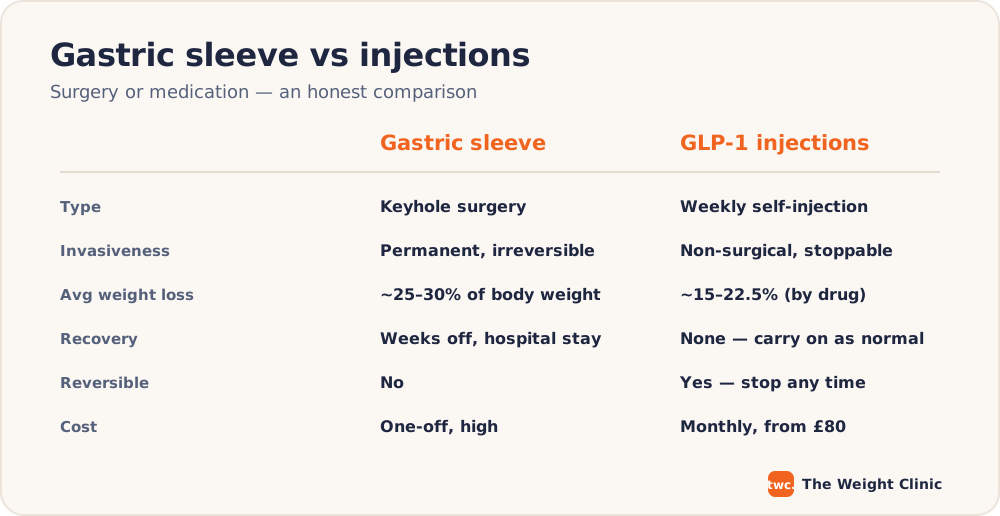
Gastric sleeve vs injections: a side-by-side comparison
| Factor | Gastric sleeve | Weight-loss injections (Mounjaro / Wegovy) |
|---|---|---|
| What happens | Roughly 75–80% of the stomach removed permanently | Weekly injection; no anatomical change |
| Reversible? | No | Yes — dose can be adjusted or stopped |
| Anaesthetic / hospital | General anaesthetic, typically 1–3 nights in hospital | None; taken at home |
| Recovery time | Several weeks; staged liquid-to-solid diet | No downtime |
| Typical results | Around 25–30% of total body weight, per NHS/NICE bariatric-surgery data | ~22.5% (tirzepatide, SURMOUNT-1); ~14.9% (semaglutide, STEP-1) |
| UK eligibility | Usually BMI 40+, or 35+ with a serious weight-related condition | MHRA licence: BMI 30+, or 27+ with a weight-related condition |
| Typical UK private cost | Roughly £8,000–£12,000, one-off (general market range) | From £160/month (Mounjaro) at The Weight Clinic; ongoing |
| Ongoing commitment | Lifelong diet changes and daily vitamins | Continue while it suits you; lifestyle changes still matter |
| Main downsides | Surgical risk, irreversibility, reflux, dumping syndrome | Nausea and GI effects; rare serious risks; cost is recurring |
The table simplifies real clinical nuance, but it captures the core tension. Surgery is a bigger up-front step with a one-off cost and a permanent outcome. Medication is lower-commitment and flexible, but it is an ongoing expense and, for most people, an ongoing treatment.
Who qualifies for each in the UK
Eligibility is not just about wanting a particular option — it is about clinical thresholds and safety.
For a gastric sleeve, UK criteria are demanding. You generally need a BMI of 40 or higher, or 35 or higher if you have a significant weight-related condition such as type 2 diabetes. On the NHS you also normally have to show you have engaged with structured weight-management support first, and you go through assessments with a surgeon, a dietitian, and often a psychologist. Waiting lists can be long, and privately the cost runs to several thousand pounds.
For weight-loss injections, the MHRA-licensed threshold is lower — BMI 30+, or 27+ with a weight-related comorbidity — because the risk profile is different from major surgery. That allows earlier intervention, before weight-related complications become entrenched. It still involves a proper clinical assessment: a prescriber reviews your history, current medicines, and any red flags before anything is dispensed.
Neither is a shortcut. Both work best alongside changes to how you eat and move, and both should be entered into with clear eyes about what maintenance looks like afterwards.
Recovery and daily life
This is where the two paths feel most different in practice.
After a sleeve, you can expect one to three nights in hospital and commonly around two to six weeks before you are back to normal activity. The diet is staged deliberately: clear liquids first, then purées, then soft foods, before solids — partly to protect the internal staple line while it heals. Your long-term stomach capacity is small (often around 150ml), so portions stay modest for life, and daily vitamin and mineral supplements become essential to avoid deficiencies. Many people adapt well; the point is that these are permanent adjustments, not a temporary phase.
With injections, there is no operation and no recovery period — you carry on with normal life while the medicine works in the background. The trade-off is on the side-effect side rather than the surgical side, which brings us to safety.
Safety: what to weigh on both sides
Every effective treatment carries risk, and being balanced about it matters.
Sleeve surgery carries the risks of any major operation — anaesthetic risk, bleeding, and infection — plus procedure-specific issues. Chronic acid reflux is a recognised long-term complication and can mean ongoing medication. Rapid weight loss raises the chance of gallstones, sometimes needing a further operation. "Dumping syndrome" — nausea, sweating, and dizziness after sugary or fatty food — is common and, over time, discourages those foods. Nutritional deficiencies are a real risk without lifelong supplementation, and a minority of people regain weight if underlying habits are not addressed.
GLP-1 injections most commonly cause gastrointestinal side effects: nausea, vomiting, diarrhoea, and constipation, usually worst when a dose is first increased and often easing with time. More serious but rare risks include pancreatitis and gallbladder problems (including gallstones, which rapid weight loss itself can also drive). They are not suitable for everyone — for example, they are contraindicated in pregnancy and in people with a personal or family history of medullary thyroid cancer or MEN 2 syndrome — which is exactly what a prescriber screens for.
If you take a GLP-1 medicine and experience a side effect, you can report it through the MHRA Yellow Card scheme at yellowcard.mhra.gov.uk. Seek urgent medical advice for anything severe, such as persistent severe abdominal pain, which can be a sign of pancreatitis.
How to actually decide
There is no universally "right" answer — the sensible choice depends on your numbers, your health, and your appetite for risk and permanence. A few honest prompts:
- How high is your BMI, and do you have weight-related conditions? Very high BMI with serious comorbidities is the situation surgery was designed for. A BMI in the 27–35 range often points toward a medical route first.
- How do you feel about permanence? If the irreversibility of a sleeve unsettles you, a treatment you can stop may suit you better.
- What about cost and timing? Surgery is a large one-off outlay (or a long NHS wait); medication is a smaller recurring cost you can begin sooner.
- Can you commit to the aftercare? Neither option works on its own. Both need lasting changes to hold onto the results.
Many people reasonably start with a medical route and keep surgery as a later consideration. Others, particularly at the highest BMIs, are better served by surgery from the outset. A clinical assessment is the fastest way to find out which camp you are in.
How it works at The Weight Clinic
The Weight Clinic is a GPhC-registered UK online pharmacy. Our clinical team is led by Superintendent Pharmacist Andrew Lane, with prescribing by Pharmacist Independent Prescriber Fatma Al Sibahi, and medical content reviewed by Pharmacist Independent Prescriber Ali Al Sibahi.
We do not offer surgery — our focus is safe, prescriber-led medical weight management with treatments including Mounjaro and Wegovy. You complete a secure online consultation, a prescriber reviews whether treatment is clinically appropriate for you, and if it is, your medicine is delivered discreetly to your door. There is no subscription, and Mounjaro starts from £160 a month, while Wegovy starts from £115 a month; £5 tracked delivery is added per order.
If you are still deciding between surgery and medication, the eligibility check is a low-pressure place to start. Check your eligibility — it is free, and it tells you quickly whether a medical route is even an option for you.
The bottom line
A gastric sleeve and weight-loss injections both treat obesity as the medical condition it is, but they sit at different points on a spectrum of risk and permanence. Surgery removes most of the stomach for good and asks a lot up front; injections offer a flexible, lower-commitment medical path with strong trial evidence behind them, at the price of ongoing treatment. Get your BMI and health picture assessed by a prescriber, weigh reversibility and cost honestly, and choose the path you can actually sustain.
Frequently asked questions
Are weight-loss injections as effective as a gastric sleeve?
They can produce results in a similar range, but they are not identical. In the SURMOUNT-1 trial, adults on tirzepatide 15mg (Mounjaro) lost on average about 22.5% of body weight over 72 weeks, and in STEP-1, adults on semaglutide 2.4mg (Wegovy) lost about 14.9% over 68 weeks. Gastric sleeve surgery is commonly associated with around 25–30% total body-weight loss per NHS/NICE bariatric data. Individual results vary, and weight can return if treatment or lifestyle changes stop.
Do I need a prescription for Mounjaro or Wegovy?
Yes. Mounjaro and Wegovy are prescription-only medicines. In the UK they are supplied only after an online consultation and clinical assessment by a prescriber, who checks your history, BMI, and suitability. They should never be bought without a prescription.
What are the UK eligibility rules for each option?
For weight-loss injections, the MHRA-licensed criteria are broadly a BMI of 30 or above, or 27 or above with a weight-related condition such as type 2 diabetes or high blood pressure. For a gastric sleeve, UK criteria are stricter — usually a BMI of 40 or higher, or 35 or higher with a serious weight-related condition — and NHS access also requires prior engagement with structured weight-management support.
What are the main risks of each?
Sleeve surgery carries the risks of any major operation (anaesthetic, bleeding, infection) plus reflux, dumping syndrome, gallstones, and nutritional deficiencies without lifelong supplements. GLP-1 injections most often cause nausea and other gastrointestinal effects, with rare but serious risks including pancreatitis and gallbladder problems. If you experience a side effect on a GLP-1 medicine, report it via the MHRA Yellow Card scheme at yellowcard.mhra.gov.uk and seek urgent advice for severe symptoms such as persistent severe abdominal pain.