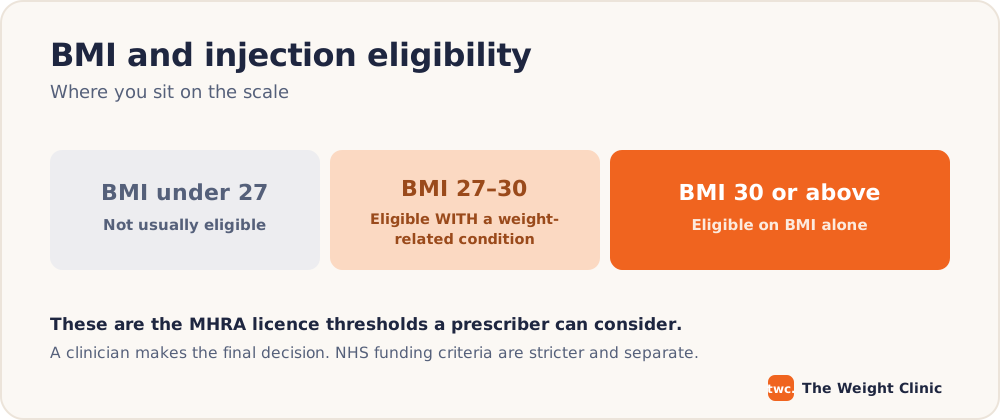
If you are wondering whether you qualify for a weight loss injection like Mounjaro or Wegovy, the answer usually comes down to a single number: your Body Mass Index (BMI). In the UK, these medicines are licensed for adults with a BMI of 30 or above, or a BMI of 27 or above alongside a weight-related health condition. Meet that threshold and you may be eligible for treatment after a clinical assessment. Fall below it, and a prescriber cannot legally supply the medicine, because the licence it holds does not cover lower weights.
That is the short version. But BMI is more nuanced than a calculator suggests, the thresholds shift for some people, and eligibility is never decided by a number alone. This guide explains exactly how BMI is used to decide who can access weight loss injections, why the cut-offs exist, and what happens if you are close to the line.
What is BMI, and why does it decide eligibility?
BMI is a ratio of your weight to your height: your weight in kilograms divided by your height in metres squared. A person who weighs 90kg and stands 1.7m tall has a BMI of roughly 31.
It is a screening tool, not a diagnosis. BMI does not measure body fat directly, and it does not know whether the kilograms on your frame are muscle or fat. What it does well is flag, quickly and cheaply, when someone's weight is likely to be raising their risk of conditions like type 2 diabetes, high blood pressure, sleep apnoea and heart disease. That is why the whole regulatory framework around weight loss injections is built on it.
When the Medicines and Healthcare products Regulatory Agency (MHRA) approved these medicines, it approved them for defined weight ranges, because those are the ranges in which the clinical trials proved they were both effective and reasonably safe. A prescriber working outside the licensed BMI range is prescribing "off-label" for a purpose the evidence does not support, which a responsible clinician will not do for cosmetic weight loss. So your BMI is not a hurdle a clinic invented. It is the boundary of what the licence, and the evidence, actually permits.
The UK BMI thresholds for weight loss injections
There are two thresholds that matter for the injectable GLP-1 and dual-agonist medicines. Here they are for Mounjaro (tirzepatide) and Wegovy (semaglutide), which share the same licensed criteria.
| Your situation | BMI needed to be eligible |
|---|---|
| No weight-related health condition | 30 or above |
| At least one weight-related health condition | 27 or above |
A "weight-related health condition" (sometimes called a comorbidity) is one that is caused or worsened by excess weight and is likely to improve if you lose weight. Common examples include:
- Type 2 diabetes or prediabetes
- High blood pressure (hypertension)
- Raised cholesterol or other blood fats
- Obstructive sleep apnoea
- Non-alcoholic fatty liver disease
- Osteoarthritis linked to joint loading
- Polycystic ovary syndrome (PCOS)
If you have one of these and your BMI is 27 or more, you may qualify even though you sit below the standard 30 mark. This is the licensed criterion set by the MHRA, and it is broader than the stricter cohorts the NHS uses to decide who it will fund on the health service. In other words: you can be eligible to be prescribed one of these medicines through a private pharmacy while not meeting the specific criteria the NHS applies to its own limited funding.
Do the thresholds change for some people?
Yes. BMI was largely developed using data from White European populations, and it can under-estimate weight-related health risk in people of South Asian, Chinese, other Asian, Middle Eastern, Black African and African-Caribbean family background. People from these groups can develop conditions like type 2 diabetes at a lower BMI.
Because of this, UK guidance recommends using lower BMI thresholds for these groups when assessing weight-related risk. In practice, a clinician may treat a BMI of around 27.5 as equivalent to the usual 30 cut-off, and around 25 as equivalent to the usual 27, when there is a weight-related condition present. If this applies to you, note it during your consultation, as it can genuinely change whether treatment is appropriate.
The reverse caveat matters too. BMI can over-estimate fat in people carrying a lot of muscle, and it does not capture where fat sits on the body. Waist measurement and your wider health picture help fill in what the number leaves out, which is one reason a prescriber, not a calculator, makes the final call.
What if my BMI is just below the line?
This is one of the most common frustrations, and it is worth being straight about. If your BMI is below the licensed threshold and you have no qualifying health condition, a prescriber cannot supply an injectable weight loss medicine. It is not a matter of persuasion or paperwork. The medicine's licence does not cover that weight, and prescribing outside it for weight loss would be clinically inappropriate.
That said, a few things are worth checking before you assume you do not qualify:
- Measure again, properly. A height taken from an old passport or a weight from carpeted scales can push your BMI a point or two in the wrong direction. Small errors matter near a threshold.
- Consider whether you have an undiagnosed comorbidity. Many people have raised blood pressure or borderline blood sugar without knowing it. A health check can move you from the 30 threshold to the 27 one.
- Ask about the oral option. For some people who want to start earlier or prefer not to inject, an oral GLP-1 tablet may be part of the conversation. You can read more on our Wegovy Tablet page.
If you are genuinely below the range, the honest answer is that these injections are not the right tool for you right now, and no reputable pharmacy should tell you otherwise.
How well do these medicines actually work?
Eligibility is only worth pursuing if the treatment does something meaningful, so it is fair to ask what the evidence shows. Two large trials underpin the headline figures, and it is important to read them as averages, not promises.
In the SURMOUNT-1 trial, adults without diabetes taking tirzepatide (the active ingredient in Mounjaro) at the highest 15mg dose lost on average around 22.5% of their body weight over 72 weeks, alongside lifestyle changes. In the STEP-1 trial, adults taking semaglutide 2.4mg (the active ingredient in Wegovy) lost on average around 14.9% of their body weight over 68 weeks. Both trials paired the medicine with reduced-calorie eating and increased activity, which matters: the injection supports the change, it does not replace it.
These are trial averages. Individual results vary widely, and some people lose considerably less. Weight can also return if treatment stops without a plan to maintain the changes. Anyone quoting a single number as what "you will" lose is overstating what the science supports.
The safety picture worth understanding
Because these are prescription medicines, the assessment exists to keep you safe, not just to tick a box. Most side effects are gastrointestinal and settle as your body adjusts: nausea, diarrhoea, constipation, indigestion and reduced appetite are the common ones, and slow dose increases are designed to soften them. Mounjaro, for example, starts at 2.5mg and increases by 2.5mg no sooner than every four weeks, up to a maximum of 15mg, precisely so your body has time to adapt.
Serious side effects are uncommon but real. These include acute pancreatitis (inflammation of the pancreas) and gallbladder problems, both of which need prompt medical attention. There are also firm contraindications: these medicines are not suitable during pregnancy or breastfeeding, for anyone with a known hypersensitivity to the active substance, or for people with a personal or family history of medullary thyroid cancer or the syndrome MEN 2. This is exactly why a prescriber needs your full medical history before deciding, and why supply always follows a clinical assessment.
If you ever experience a side effect you suspect is linked to a medicine, you can report it directly to the MHRA through the Yellow Card scheme at yellowcard.mhra.gov.uk. Reporting helps build the national safety picture for everyone.
How it works at The Weight Clinic
We are a GPhC-registered UK pharmacy, and eligibility is handled the way it should be: a real prescriber reviewing real information, not an automated yes or no.
You start with a free eligibility check, entering your height and weight and answering questions about your health and history. If your figures put you in the licensed range, your details go to one of our prescribers for a full clinical assessment. They confirm your BMI, check for any conditions that would make treatment unsafe, and decide which medicine, if any, is the right fit. Under UK rules, these are prescription-only medicines that cannot be supplied on the strength of a tick-box form alone, so identity and BMI are verified as part of that process, and a medicine is only ever dispensed after a prescriber has approved it for you.
If treatment is approved, it is dispensed from our pharmacy and posted to you, with no subscription tying you in and the freedom to stop whenever you and your prescriber agree it is right. If you would like to see where you stand, you can check your eligibility in a few minutes. It costs nothing and it is not a commitment to treatment, just a clear answer on whether the licensed criteria are met.
For more on the individual medicines and pricing, see our pages on Mounjaro, Wegovy, and the full range of weight loss injections we offer. If you are still weighing up your options, our overview of treatments sets them side by side.
The bottom line on qualifying
BMI is the gateway to weight loss injection treatment in the UK because it marks the boundary of what these medicines are licensed and proven to do. A BMI of 30 or above, or 27 or above with a weight-related condition, opens the door, with lower thresholds recognised for some ethnic groups at higher metabolic risk. From there, a prescriber, not a calculator, decides whether treatment is genuinely safe and suitable for you.
If you are on or above the line, the most useful next step is an accurate assessment. If you are below it, the honest and responsible answer is that these particular medicines are not for you yet, and a good pharmacy will tell you so rather than sell you something you should not have.
Frequently asked questions
What BMI do I need to qualify for weight loss injections in the UK?
Mounjaro and Wegovy are licensed for adults with a BMI of 30 or above, or 27 or above if you also have a weight-related health condition such as type 2 diabetes, high blood pressure or obstructive sleep apnoea. These are the criteria set by the Medicines and Healthcare products Regulatory Agency (MHRA), and they are broader than the stricter cohorts the NHS uses for its own funding. Eligibility is confirmed by a prescriber after a clinical assessment, not by a calculator alone.
Are the BMI thresholds lower for some ethnic groups?
Yes. Because BMI can under-estimate weight-related health risk in people of South Asian, Chinese, other Asian, Middle Eastern, Black African and African-Caribbean family background, UK guidance recommends lower thresholds for these groups. In practice a clinician may treat a BMI of around 27.5 as equivalent to the usual 30 cut-off, and around 25 as equivalent to the usual 27 where a weight-related condition is present. Mention it during your consultation, as it can change whether treatment is appropriate.
What happens if my BMI is just below the threshold?
If your BMI is below the licensed threshold and you have no qualifying health condition, a prescriber cannot legally supply an injectable weight loss medicine, because that would fall outside the licence. It is worth re-measuring your height and weight accurately, and considering whether you have an undiagnosed comorbidity such as raised blood pressure that could move you from the 30 threshold to the 27 one. If you are genuinely below the range, a reputable pharmacy will tell you these injections are not the right option for you right now.
How much weight can these medicines help you lose?
In the SURMOUNT-1 trial, adults without diabetes taking tirzepatide (Mounjaro) at 15mg lost on average around 22.5% of their body weight over 72 weeks alongside lifestyle changes. In the STEP-1 trial, adults taking semaglutide 2.4mg (Wegovy) lost on average around 14.9% over 68 weeks. These are trial averages, not promises; individual results vary and weight can return if treatment stops without a maintenance plan.
Can I buy weight loss injections without a prescription?
No. Mounjaro and Wegovy are prescription-only medicines and can only be supplied after an online consultation and clinical assessment by a prescriber. This is why supply always involves confirming your BMI, reviewing your medical history and verifying your identity. If you experience a side effect you suspect is linked to a medicine, you can report it to the MHRA through the Yellow Card scheme at yellowcard.mhra.gov.uk.